Background:
Takotsubo syndrome (TTS) is an acute heart failure syndrome characterised by transient left ventricular (LV) systolic dysfunction typically precipitated by intense emotional and/or physical stress. Clinical studies demonstrate an increased prevalence of anxiety and depression in TTS patients, identifying them as important predisposing factors. These observations implicate dysregulation of the hypothalamic-pituitary-adrenal (HPA) axis and glucocorticoid receptor (GR) signalling in disease susceptibility. FK506-binding protein 51 (FKBP5) is a stress-responsive co-chaperone that negatively regulates GR signalling and was shown to impair GR nuclear translocation. We hypothesised that impaired GR signalling contributes to TTS pathogenesis and that pharmacologic inhibition of FKBP5 by SAFit2 restores cardioprotective GR signalling.
Methods and Results:
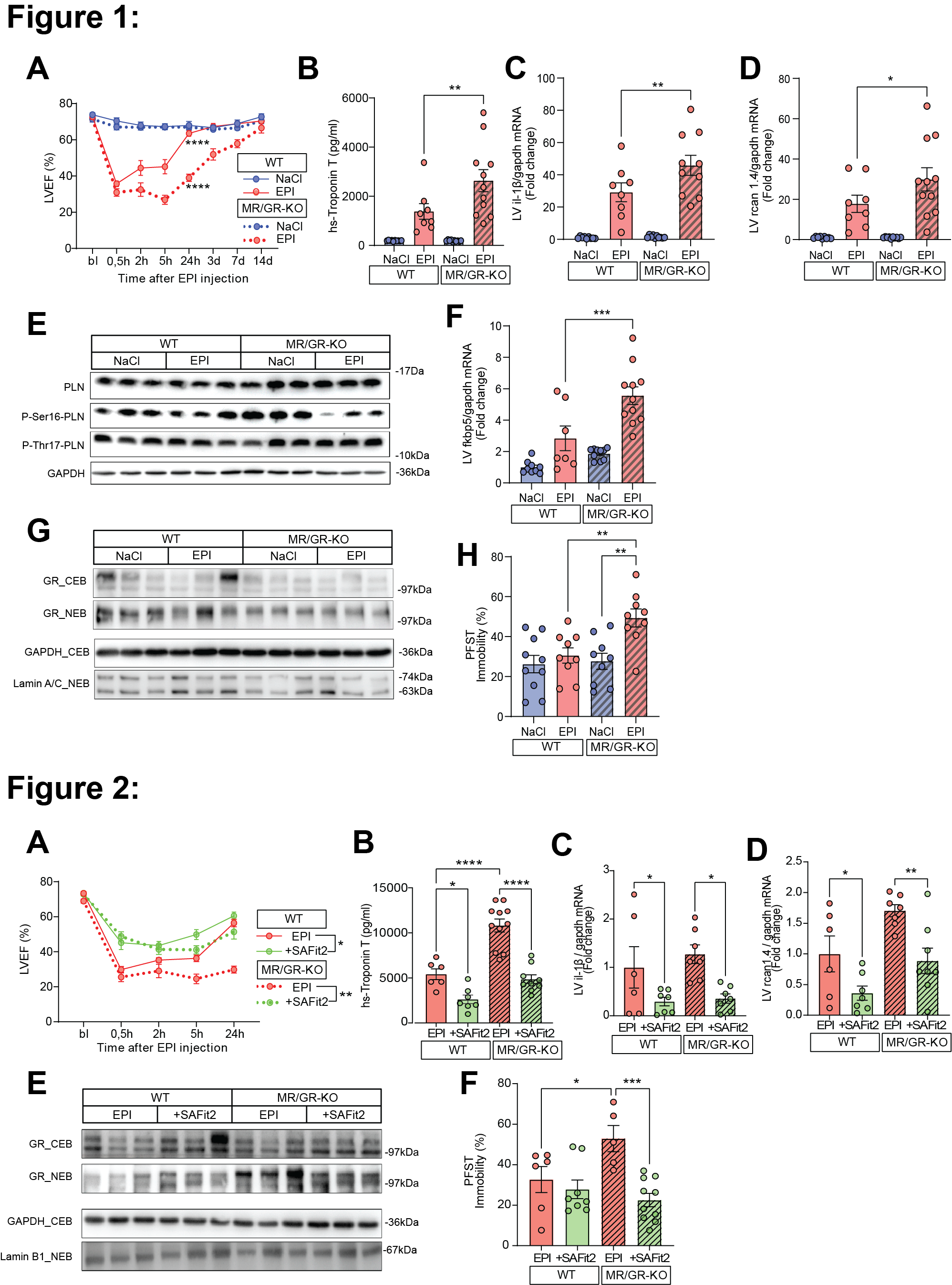
To investigate the interaction between affective stress vulnerability and cardiac dysfunction, we employed mice with inducible forebrain-specific deletion of mineralocorticoid and glucocorticoid receptors (MR/GR-KO), a model of HPA-axis dysregulation and vulnerability to stress-induced depression-like behaviour. Mice were then subjected to an established murine model of epinephrine (EPI)-induced TTS (eTTS). Following EPI injection, MR/GR-KO mice showed eTTS phenotype exacerbation compared to WT littermates, characterised by a greater reduction in LV ejection fraction (LVEF; ****p<0.0001 WT EPI vs KO EPI at 24h, n=5-13/group, 2-way ANOVA, Fig.1A), increased myocardial injury (hs-Troponin T; **p<0.01 WT EPI vs KO EPI at 24h, 1-way ANOVA, Fig.1B), enhanced pro-inflammatory signalling (il-1β, rcan1.4; *p<0.05, **p<0.01 WT EPI vs KO EPI at 24h, 1-way ANOVA, Fig.1C&D), and blunted PKA activity as indicated by reduced phospholamban Ser16 phosphorylation (Fig.1E). Importantly, MR/GR-KO mice displayed an even more pronounced LV FKBP5 expression upon EPI (***p<0.001 WT EPI vs MR/GR-KO EPI at 24h, 1-way ANOVA, Fig.1F). To assess GR signalling, LV GR localisation was analysed by subcellular fractionation. Nuclear GR protein levels were reduced in WT mice 24h after EPI and were blunted in MR/GR-KO mice, indicating dampened GR signalling (Fig.1G). Treatment with SAFit2, a selective FKBP5 inhibitor, significantly improved LVEF (*p<0.05 WT EPI vs WT +SAFit2; **p<0.01 KO EPI vs KO +SAFit2, n=5-13/group, t-test, Fig.2A), reduced myocardial injury (*p<0.05, WT EPI vs WT +SAFit2; ****p<0.0001 KO EPI vs KO +SAFit2 at 24h,1-way ANOVA, Fig.2B), and attenuated inflammation (*p<0.05, WT EPI vs WT +SAFit2; *p<0.05, **p<0.01 KO EPI vs KO +SAFit2 at 24h, 1-way ANOVA, Fig.2C&D), accompanied by increased LV GR nuclear translocation (Fig.2E). Regarding long-term behavioural consequences, MR/GR-KO mice developed depressive-like behaviour 1 month after EPI (**p<0.01 WT EPI vs KO EPI; **p<0.01 KO NaCl vs KO EPI, 1-way ANOVA, Fig.1H), which was significantly improved by SAFit2 (*p<0.05, WT EPI vs KO; ***p<0.001 KO EPI vs KO +SAFit2, 1-way ANOVA, Fig.2F).
Conclusion:
These findings identify FKBP5 as a molecular link between depression-associated MR/GR dysregulation, maladaptive GR signalling, and stress-induced heart failure. Pharmacological FKBP5 inhibition by SAFit2 restored LV GR nuclear translocation and protected against cardiac dysfunction and depressive-like behaviour in eTTS. The FKBP5-GR axis, therefore, represents a novel mechanistic link between affective disorders and TTS and a promising therapeutic target.