Introduction
In patients with symptomatic atrial fibrillation (AF), pace and ablate (P&A) strategy, combining atrioventricular (AV) node ablation with permanent pacing, represents a therapeutic alternative besides pharmacological rate control and ablation therapy with pulmonary vein isolation. Previous studies have demonstrated that P&A in patients with heart failure was associated with lower re-hospitalization and mortality rates compared to pharmacological rate control. Furthermore, it may facilitate spontaneous sinus rhythm restoration (SSRR) and a reduction in atrial fibrillation burden.The aim of this study was to evaluate different pacing modalities as potential determinants of SSRR and left ventricular ejection fraction (LVEF) alteration in patients assigned to a P&A strategy.
Methods
This single-center retrospective cohort study included all patients with AF and P&A strategy during the inclusion period from 01/2023 to 04/2026. Pacemaker data and electrocardiograms were obtained and analysed at two different timestamps, 1-3 months and secondly 6-12 months after AV node ablation. The underlying atrial rhythm, NT-proBNP levels, paced QRS-width and changes in left ventricular ejection fraction (LVEF) were assessed and compared with respect to physiological pacing modalities (biventricular pacing [BiV], conduction system pacing [CSP]) and non-physiological pacing (right ventricular pacing [RV]).
Results
Our final study population included 79 patients. 42 (53,2%) male patients, median age 80 years [75–86]. Within this cohort 39 (49.4%) patients received RV pacing and 40 (50.6%) BiV-pacing/CSP. Sustained SSRR was observed in 6 out of 79 patients (7.6%), including 2 patients (5.1%) in the RV group and 4 patients (10.0%) in the combined BiV/CSP group. The median QRS-width in the overall cohort was 144ms [130–160], 142ms [121–160] in the combined BiV/CSP group, and 130ms [120–160] for CSP alone, respectively. In 42 out of 79 patients a baseline and follow-up LVEF was assessed and analyzed with respect to LVEF change (see figure 1). Our analysis revealed a median LVEF of 45% [35-55] in the overall cohort, 55% [45–60] in the RV group and in the BiV/CSP group 38% [25-45] at baseline prior AV node ablation. After follow-up median LVEF was 50% [35-55] overall, 50% ([44–55] in the RV group (p= 0.32 vs. baseline; figure 1) and 40% [33-50] in the BiV/CSP group showing a numerical positive change but not reaching significance (p= 0.18 vs baseline; figure 1).
Discussion
CSP and BiV-pacing show a proportionally higher rate of SSRR supporting the currently discussed hypothesis that physiological pacing may function as a predictive factor. Furthermore, we could determine a numerical but non-significant positive change in LVEF under physiological pacing modality after AV node ablation suggesting a potential positive effect of BiV-Pacing or CSP in patients with P&A-strategy, which has to be further evaluated in larger cohorts.
Table1
Baseline characteristics of the study population
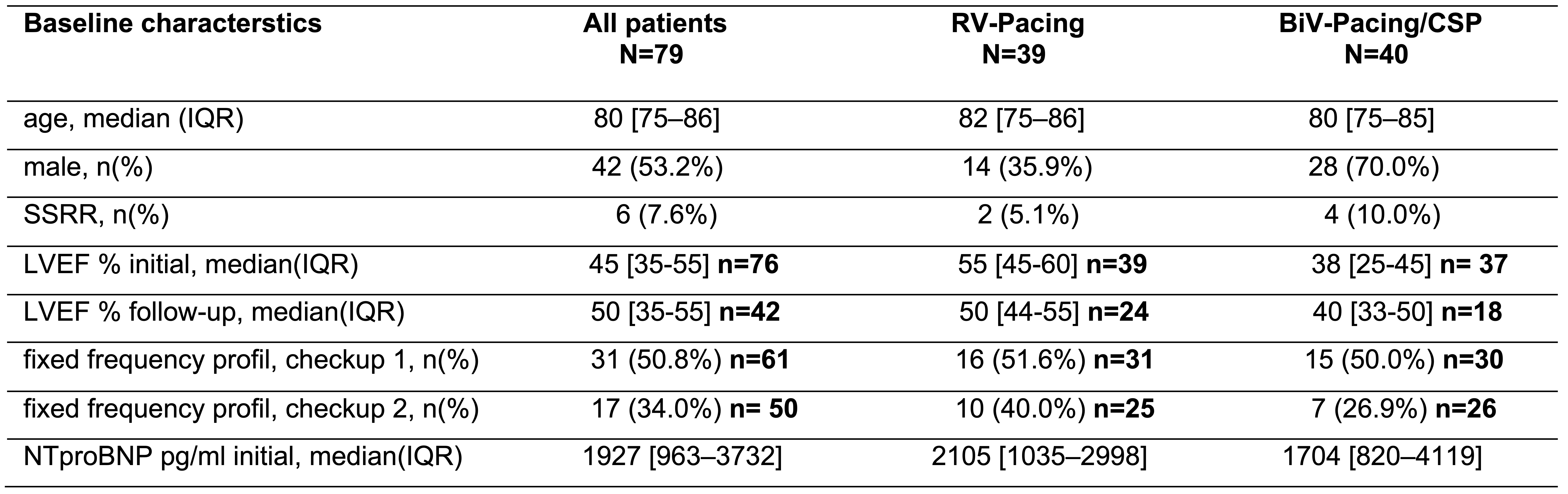
BiV = biventricular pacing, CSP = conduction system pacing, initial = time of AV node ablation, IQR = interquartile range, LVEF = left ventricular ejection fraction, NTproBNP = N-terminal pro-B-type natriuretic peptide, SSRR = spontaneous sinus rhythm restoration
Figure 1
Change in LVEF pre- and post AV node ablation
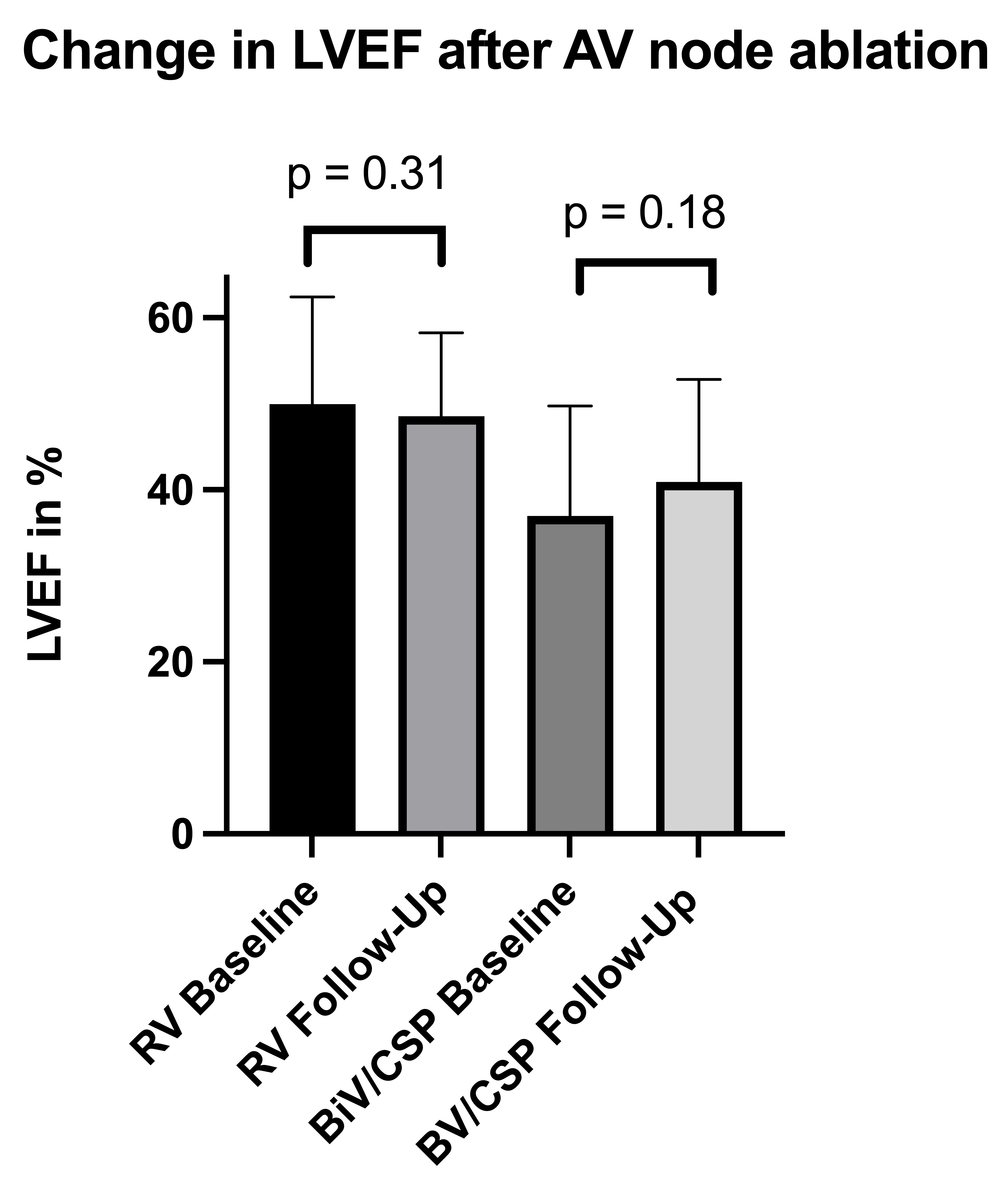
BiV = biventricular pacing, CSP = Conduction system pacing, LVEF = left ventricular ejection fraction, RV = right ventricular pacing



