BackgroundPacing-induced cardiomyopathy (PICM) is a clinically relevant long-term complication of chronic right ventricular pacing, driven by ventricular dyssynchrony leading to progressive heart failure. Despite increasing awareness, longitudinal clinical and electrocardiographic trajectories and patient characteristics preceding cardiac resynchronization therapy (CRT) upgrade remain incompletely understood.
MethodsIn this retrospective single-center study, consecutive patients undergoing CRT upgrade after pacemaker implantation between 2010 and 2025 were analyzed. Clinical, electrocardiographic, echocardiographic and device-related parameters were extracted from electronic medical records at baseline prior to implantation, during post-implantation follow-up (6–20 weeks), and prior to CRT upgrade. Continuous variables are presented as median with interquartile range (IQR) or mean ± standard deviation (SD) and categorical variables as counts and percentages. Patients with incomplete datasets were excluded.
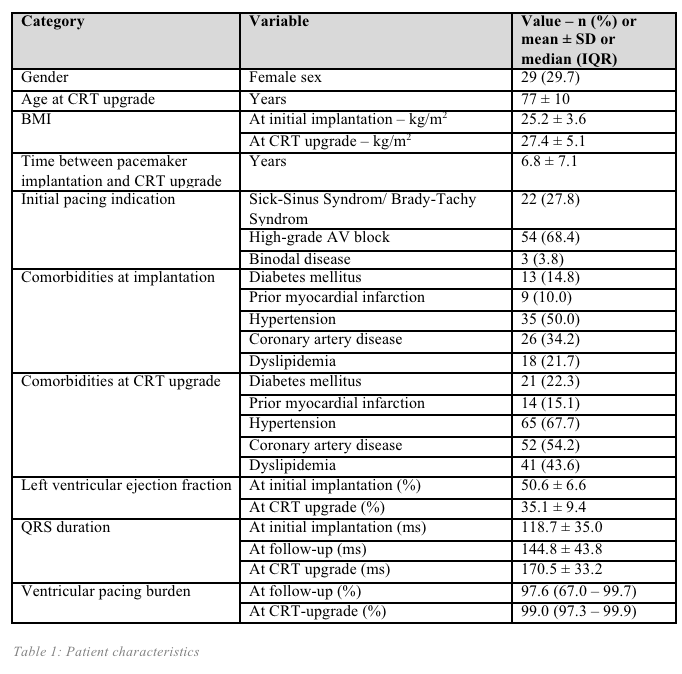
ResultsA total of 101 patients were included (70.3 % male, mean age 77 ± 10 years). The mean interval between initial pacemaker implantation and CRT upgrade was 6.8 ± 7.1 years. Initial pacing indications were high-grade AV block (68.4 %), sick sinus syndrome/ brady-tachy-syndrome (27.8 %) and binodal disease (3.8 %).
Cardiovascular comorbidities increased over time, with hypertension, coronary artery disease, and diabetes mellitus being most prevalent at baseline and more frequently documented at CRT upgrade. Median right ventricular pacing burden was high after initial implantation (97.6 [67.0 – 99.7]) and prior to CRT upgrade (99.0 [97.3 – 99.9]).
Electrocardiographic analysis showed progressive QRS prolongation (118.7 ± 35.0 ms at baseline vs. 144.8 ± 43.8 ms at follow-up vs. 170.5 ± 33.2 ms before CRT-upgrade, majority under stimulation during follow-up and before CRT-upgrade; p < 0.01). Left ventricular ejection fraction showed a significant decline over time, decreasing from 50.6 ± 6.6 % at baseline to 35.1 ± 9.4 % prior to CRT upgrade (p < 0.001). Data are shown in Table 1.
ConclusionPICM is characterized by a progressive trajectory of increasing right ventricular pacing burden, QRS prolongation, and declining left ventricular function. These findings provide insights into the clinical trajectory preceding CRT upgrade and may help identify patients at risk for PICM earlier in the disease course, potentially enabling timely intervention before advanced heart failure develops.