Background: Pulsed field ablation (PFA) with a variable-loop circular catheter (VLCC) is a tissue-selective alternative to thermal energy for pulmonary vein isolation (PVI), whereas (very) high-power radiofrequency (RF) ablation with a contact-force catheter is an established thermal strategy for efficient PVI. Head-to-head data for the two technologies obtained under a single, consistent near-zero fluoroscopy workflow are lacking.
Methods: We analysed 507 consecutive patients undergoing first-time PVI for paroxysmal or persistent atrial fibrillation (AF) at a single centre under a near-zero fluoroscopy workflow: 221 treated with the VARIPULSE™ VLCC (PFA) and 286 with the QDOT MICRO™ catheter (QDOT-RF; high-power RF using 90 W/4 s and/or temperature-controlled 50 W at operator discretion). Baseline and procedural characteristics were compared. To account for baseline differences, 1:1 propensity-score (PS) matching on six covariates was performed. Freedom from atrial tachyarrhythmia (AT/AF >30 s) after a 60-day blanking period was estimated by Kaplan–Meier analysis and compared by the log-rank test and Cox regression.
Results: Complete pulmonary vein isolation at the end of the procedure was achieved in 100% of patients in both groups. Skin-to-skin procedure time was shorter with PFA (40 [32–48] vs 47 [39–59] min, p<0.001). Both workflows achieved near-zero radiation exposure; fluoroscopy time was very low in both arms and modestly lower with PFA (0.67 [0.37–1.28] vs 0.92 [0.52–1.61] min, p=0.012), as was dose-area product (15.8 vs 26.4 cGy·cm², p=0.007). Peri-procedural complications were rare (PFA 0.9%, RF 0.35%), with no esophageal injury, atrio-esophageal fistula, or phrenic nerve palsy. PS matching yielded 177 well-balanced pairs (all standardized mean differences <0.10). Kaplan–Meier estimated 12-month freedom from AT/AF was comparable: 80.6% (95% CI 74–87) for PFA vs 79.8% (73–85) for RF in the full cohort (log-rank p=0.77) and 81.3% vs 85.0% in the matched cohort (log-rank p=0.68; Cox HR for PFA vs RF 1.13, 95% CI 0.63–2.02).
Conclusion: Under an identical near-zero fluoroscopy workflow, PFA with a variable-loop circular catheter and QDOT-RF ablation achieved complete pulmonary vein isolation in 100% of patients with low complication rates and comparable 12-month arrhythmia-free survival. PFA delivered shorter procedure times and lower radiation metrics. These real-world, PS-matched data position the VLCC as a competitive alternative to QDOT-RF, while longer follow-up is needed to confirm long-term efficacy.
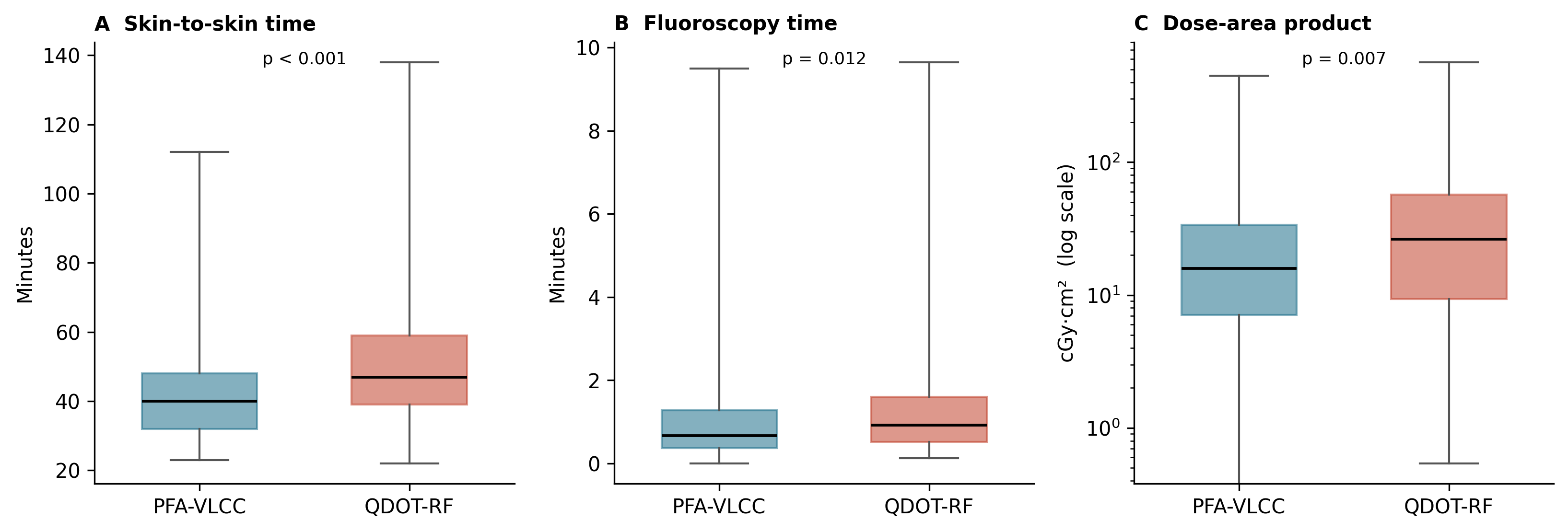
Figure 1. Procedural metrics by energy platform. Box plots (median, IQR, whiskers to minimum and maximum, outlier markers omitted) for (A) skin-to-skin procedure time, (B) fluoroscopy time, and (C) dose-area product on a logarithmic scale. PFA was associated with shorter procedure time and lower radiation metrics, although both platforms achieved near-zero exposure.
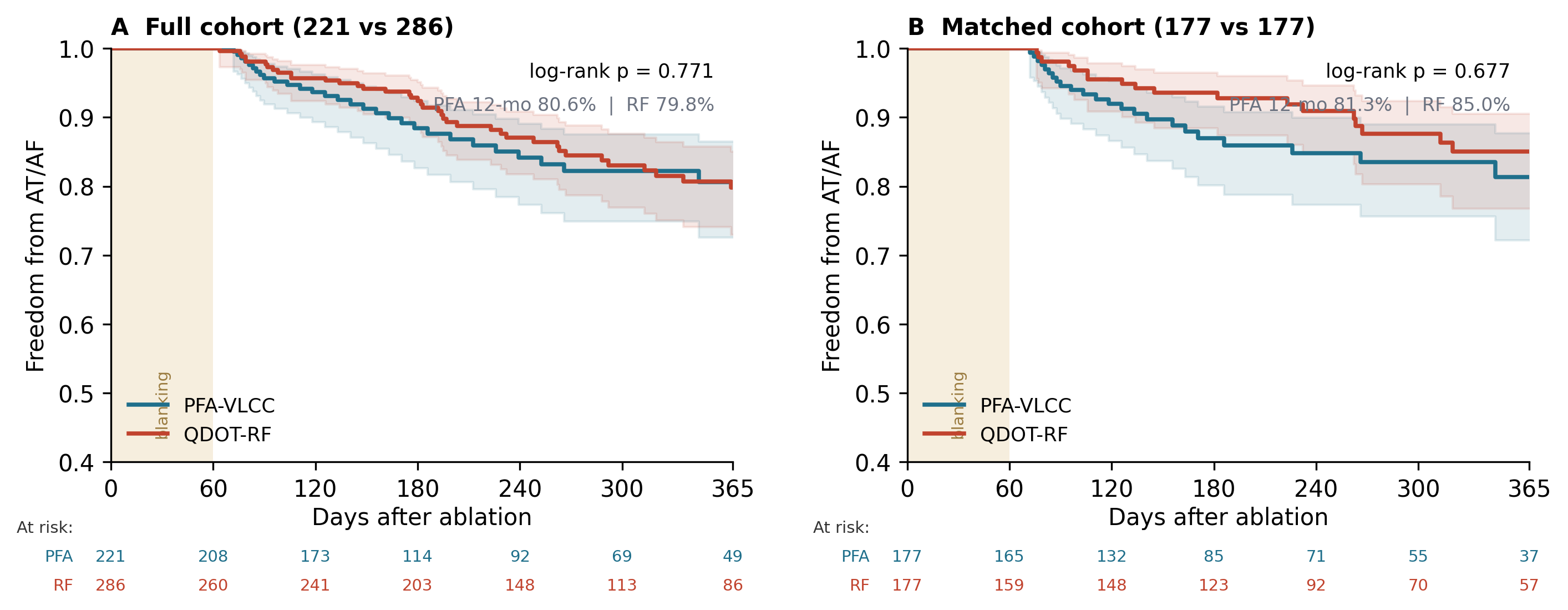
Figure 2. Kaplan–Meier freedom from atrial tachyarrhythmia (AT/AF >30 s) after a 60-day blanking period (shaded). (A) Full cohort (221 PFA vs 286 RF); (B) propensity-matched cohort (177 vs 177). Shaded bands are 95% confidence intervals (Greenwood). Numbers at risk are shown below each panel. Differences were not statistically significant in either analysis.



