Background and aims
Catheter ablation of premature ventricular complexes (PVCs) arising from anatomically challenging locations remains technically demanding and is associated with variable procedural success. A novel contact force-sensing focal catheter enables both radiofrequency (RF) ablation and pulsed field ablation (PFA) using a single platform, potentially combining the advantages of both energy sources.
We aimed to evaluate the safety and acute efficacy of dual-modality focal catheter ablation for the treatment of complex PVCs.
Methods
This is a prospective, single centre, observational study. Consecutive patients undergoing PVC ablation with a novel dual-modality RF/PFA focal catheter at our centre were prospectively enrolled between February 2026 and June 8, 2026. The choice and sequence of energy delivery (RF and/or PFA) were determined by the operator. Baseline characteristics, procedural data, acute procedural success, and in-hospital safety outcomes were prospectively collected and analysed descriptively.
Results
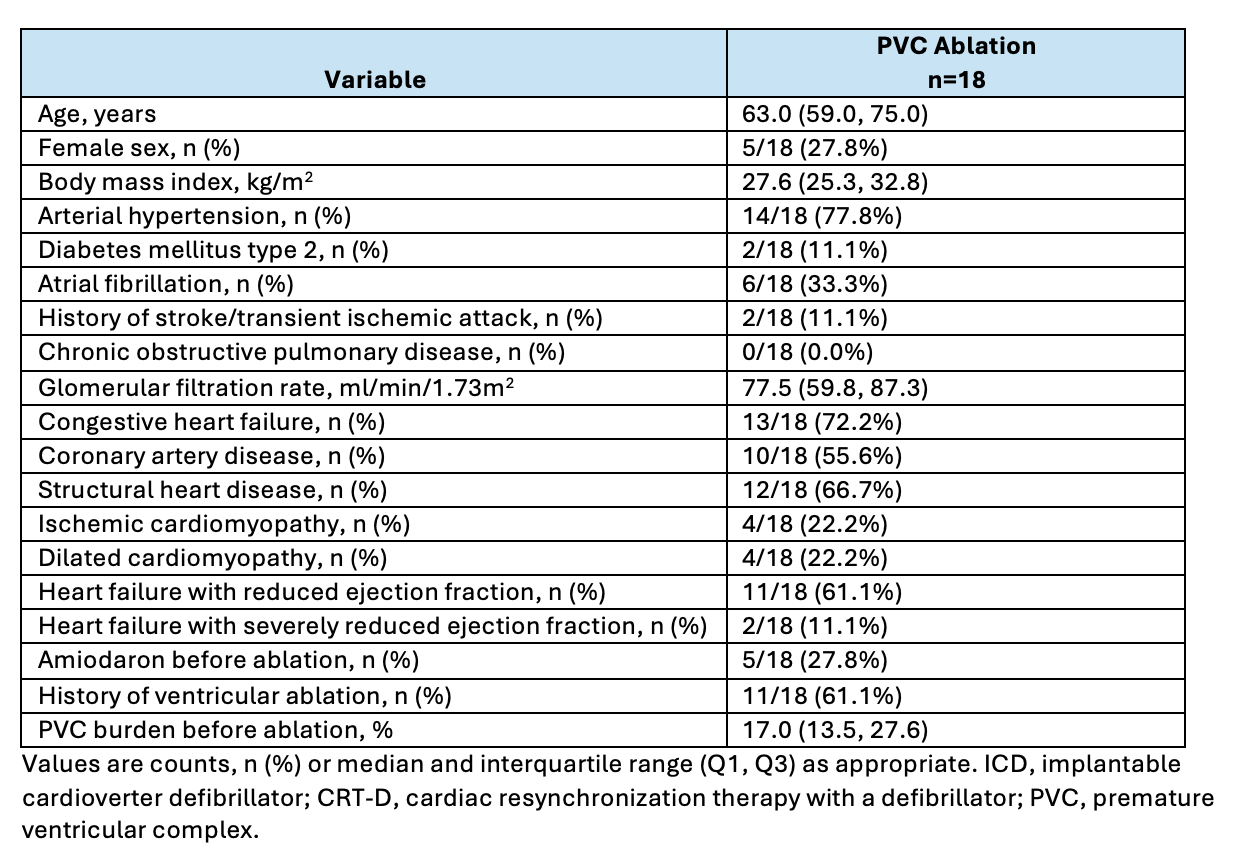
During the study period, 18 patients underwent PVC ablation using the dual-modality focal catheter (age 63.0 [IQR 59.0–75.0] years; 27.8% female; body mass index 27.6 [IQR 25.3–32.8] kg/m²). Structural heart disease was present in 12 (66.7%) patients, including ischemic cardiomyopathy in 4 (22.2%) and dilated cardiomyopathy in 4 (22.2%). Coronary artery disease was present in 10 (55.6%) patients. The median pre-procedural PVC burden was 17.0% (IQR 13.5–27.6%), and 11 (61.1%) patients had undergone previous ventricular arrhythmia ablation. Amiodarone therapy was used in 5 (27.8%) patients.
The presumed PVC origin was located in the left ventricle in 14/17 (82.4%) patients, including the aortomitral continuity (n=2), left ventricular summit (n=3), and papillary muscles (n=4), and in the right ventricle in 3/17 (17.6%) patients. All procedures were performed via an endocardial approach. Mapping was performed under conscious sedation in 11 patients (61.1%) and deep sedation in the remainder. Activation mapping was feasible in 13 (72.2%) patients.
In one patient, no ablation was performed due to the occurrence of external iliac artery dissection and cessation of the procedure. PFA-only ablation was performed in 9 patients (50.0%), whereas 2 patients (11.1%) underwent RF-only ablation and the other 6 (33.3%) ablation using both technologies. Among patients treated with PFA, the median number of applications was 13 (IQR 6–26). Persistent clinical PVCs at the end of procedure were observed in 3 (16.7%) patients, including 2 patients with premature procedure termination due to complications and 1 patient with a left ventricular PVC origin that was inaccessible because of mechanical aortic and mitral valve prostheses.
Major procedure-related complications occurred in 3 patients (16.7%), including one external iliac artery dissection requiring coiling and stent implantation, one pericardial tamponade requiring pericardiocentesis, and one complete atrioventricular block requiring 2-chamber pacemaker implantation. One patient had a transient complete atrioventricular block in the presence of cardiac resynchronisation therapy.
Conclusions
PVC ablation using a novel dual-modality RF/PFA focal catheter was feasible and associated with favourable acute safety and efficacy outcomes, including in anatomically complex locations.