Background: Left atrial appendage isolation (LAAI) is a potential adjunctive ablation strategy for persistent atrial fibrillation (AF). However, data on lesion durability and left atrial appendage thrombus (LAAT) formation remain scarce. We evaluated lesion durability and LAAT incidence following LAAI.
Methods: Consecutive patients with documented LAAI and follow-up transoesophageal echocardiography and/or repeat electrophysiological assessment were retrospectively analysed. The primary endpoint was lesion durability following LAAI, the secondary endpoint comprised LAAT detected during follow-up. Lesion durability and procedural complications were assessed descriptively. Baseline clinical, echocardiographic, and procedural characteristics were compared between patients with and without LAAT. Logistic regression was used to assess the association between LAA flow velocity and LAAT after adjustment for baseline rhythm status.
Results: A total of 82 patients were included in the study. Among 77 patients undergoing repeat invasive electrophysiological assessment during planned left atrial appendage occluder implantation following LAAI, 62 (80.5%) demonstrated durable LAA isolation albeit in a cohort with previous ablation procedures. Five patients with LAAT were not reassessed. Durability of concomitant mitral isthmus ablation was 89% (17/19) after endocardial radiofrequency (RF) ablation, 80% (8/10) after combined endocardial/epicardial RF ablation, 100% (12/12) after RF plus vein of Marshall ethanol infusion, and 50% (6/12) after RF plus pulsed field ablation. Durable anterior line block was present in 48/55 patients (87%) and LAA isolation was durable in 3/4 patients (75%) after cryo isolation.
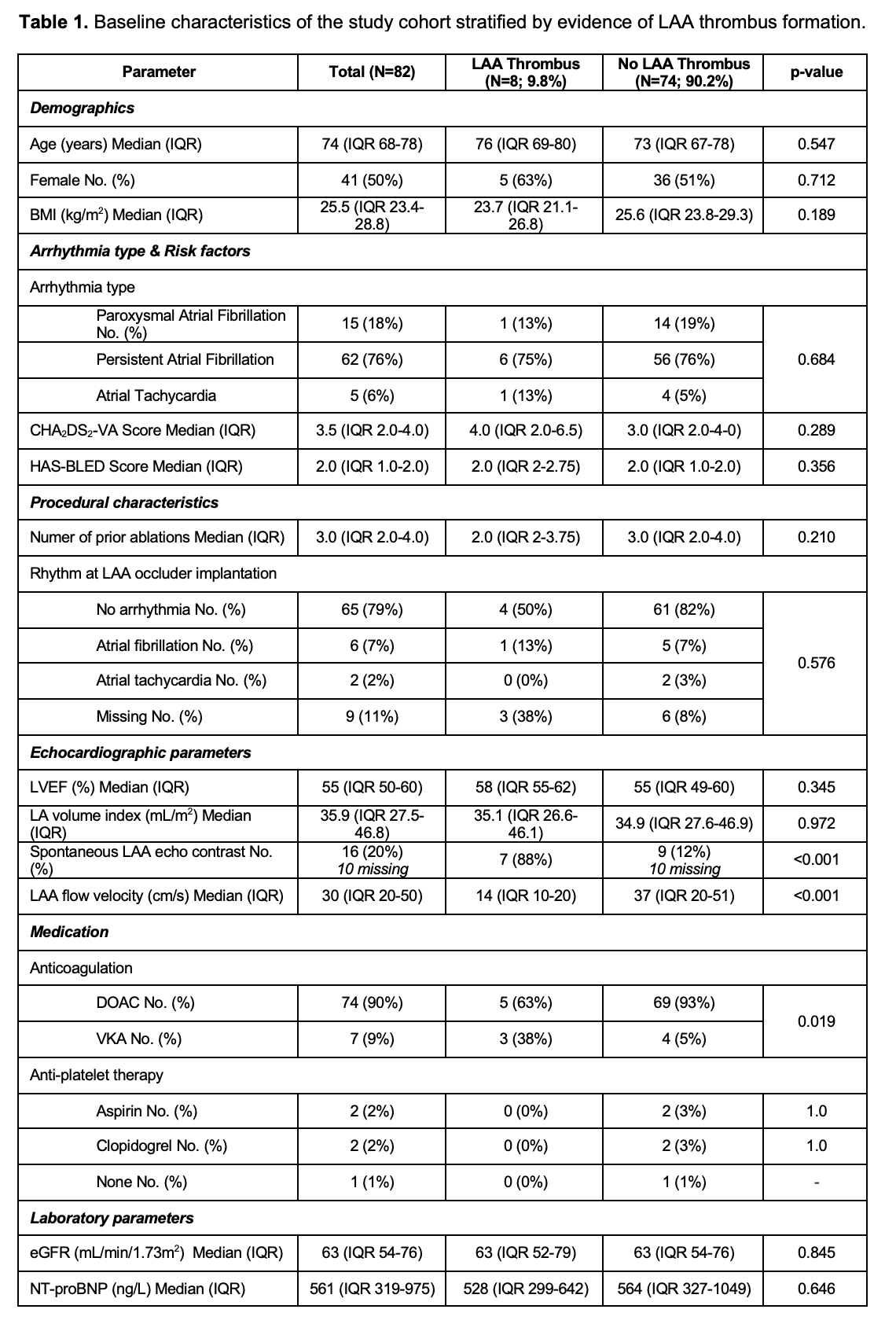
During follow-up 8/82 (9.8%) patients undergoing LAAI were diagnosed with LAAT and ischaemic stroke occurred in 3/82 (3.6%) patients; two stroke patients had documented LAAT and all three demonstrated durable LAAI. Baseline demographic, clinical, and echocardiographic characteristics were largely comparable between patients with and without LAAT. Spontaneous echo contrast was more frequent in patients with LAAT (88% vs. 12%, p<0.001), and LAA flow velocity was markedly lower (14 [IQR 10–20] vs. 37 cm/s [IQR 20–51], p<0.001) (Table 1). Lower LAA flow velocity was associated with LAAT independent of baseline rhythm status (OR 0.66, 95% CI 0.44–0.99; p=0.045). Vitamin K antagonist therapy was more common among patients with LAAT than among those without LAAT (38% vs. 5%, p=0.019), while the majority of patients without LAAT were receiving direct oral anticoagulants (93%). Procedure-related complications during LAA occluder implantation comprised bleeding events in 9/82 patients (11.0%), including 6 cardiac tamponades (one fatal), four of which were followed by pericarditis, as well as one major groin bleeding, one minor groin bleeding, and one additional minor bleeding event. Pneumothorax occurred in 1/82 patients (1.2%).
Conclusion: Durable LAA isolation was observed in 80.5% of reassessed patients. Most patients with LAAT demonstrated persistent LAA isolation, suggesting an association between durable electrical isolation and thrombus formation. LAAT occurred in approximately one in ten patients and was strongly associated with impaired LAA emptying.
*Niklas Schenker and Maria Luisa Benesch Vidal contributed equally as co-shared first authors.



