Background: Preclinical and early clinical studies suggest that renal denervation (RDN) may favourably modify pathophysiological mechanisms involved in heart failure with preserved ejection fraction (HFpEF), including ventricular–vascular coupling, pulsatile left ventricular workload, and cardiac remodelling. However, the prevalence of an HFA-PEFF-defined HFpEF phenotype among patients with uncontrolled hypertension and its modification after RDN remain insufficiently investigated.
Methods: In this observational analysis, 674 patients undergoing RDN for uncontrolled hypertension were screened. After exclusion of patients with left ventricular ejection fraction <40% or incomplete data for calculation of the Heart Failure Association Pre-test assessment, Echocardiography and natriuretic peptide, Functional testing, Final aetiology (HFA-PEFF) score, 356 patients with complete baseline and 12-month assessments were included. Patients were classified as HFpEF, requiring further evaluation, or unlikely HFpEF according to the HFA-PEFF score. Changes in HFA-PEFF classification, domain-specific abnormalities and haemodynamic parameters were assessed.
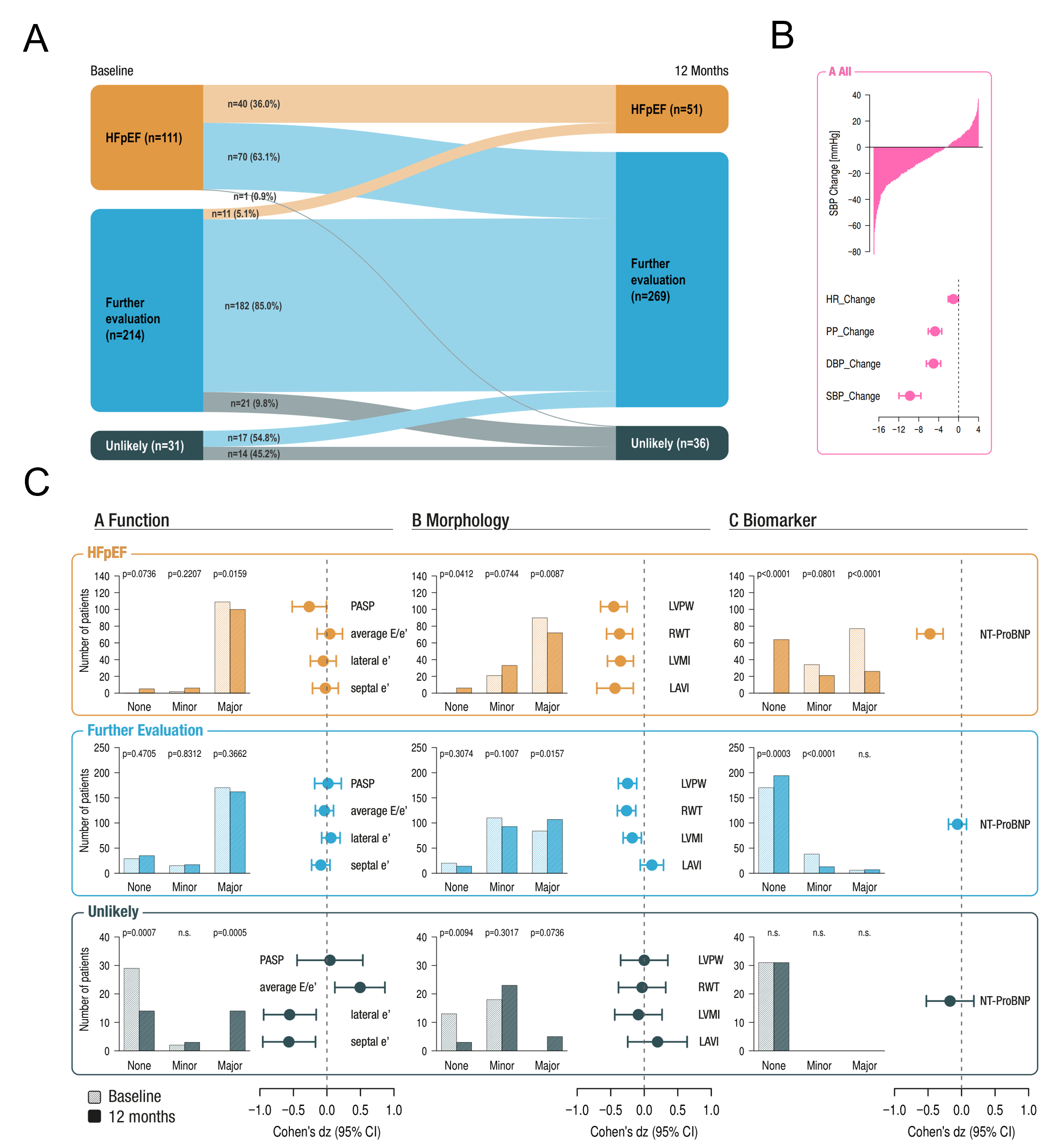
Results: At baseline, 111 patients were classified as HFpEF, 214 as requiring further evaluation, and 31 as unlikely HFpEF. At 12 months, HFpEF classification decreased to 51 patients, while further evaluation and unlikely HFpEF increased to 269 and 36 patients. Overall, 92 patients shifted to a lower HFA-PEFF probability category, indicating significant reclassification away from definite HFpEF (p<0.001). In baseline HFpEF, significant changes were observed in the functional (p=0.022), morphological (p=0.005), and biomarker domains (p<0.001). In patients requiring further evaluation, morphological (p=0.028) and biomarker domains (p<0.001) showed favourable shifts, whereas the functional domain remained unchanged (p=0.59). Paired analyses showed the strongest overall improvement in baseline HFpEF (Cohen’s dz −0.42, 95% CI −0.62 to −0.23), driven by reductions in left atrial volume index, left ventricular mass index, relative wall thickness, posterior wall thickness, and NT-proBNP. RDN significantly reduced ambulatory systolic blood pressure overall (−9.76 mmHg, 95% CI −11.96 to −7.57; p<0.001), with significant ambulatory systolic and diastolic blood pressure reductions across all baseline HFA-PEFF categories. The largest systolic reduction occurred in baseline HFpEF (−10.48 mmHg, p<0.001), followed by further evaluation (−9.68 mmHg, p<0.001) and unlikely HFpEF (−7.65 mmHg, p=0.028). Significant net shifts towards lower HFA-PEFF probability were observed in non-responders (p=0.008), responders (p<0.001), and high responders (p<0.001), with the largest reclassification effect in high responders.
Conclusion: In patients with uncontrolled hypertension, a substantial proportion fulfilled HFA-PEFF criteria for definite or intermediate HFpEF probability. RDN was associated with significant reclassification away from definite HFpEF over 12 months. Reverse HFpEF phenotyping was driven predominantly by biomarker improvement and reverse structural remodelling. Although most pronounced in high systolic blood pressure responders, reclassification was also observed in non-responders, suggesting that RDN may modify hypertensive HFpEF phenotypes beyond blood pressure reduction, potentially through sympathomodulation and reduced ventricular–vascular load.