BackgroundHeart failure (HF) increases the risk of cognitive impairment (CI), especially mild CI, which affects daily functioning, self-management of HF, and medication adherence, leading to higher rehospitalisation rates and a reduced quality of life (QoL). This study aimed to assess the prevalence of CI and mild CI in both HF patients and the general population and to identify clinical, demographic, and disease-related factors that could be associated with HF in the development of CI.
MethodsData from two sources were pooled and analysed: HF patients from the HI-PLUS cluster-randomised trial comprising 48 cardiological outpatient practices in Germany, evaluating an evidence-based care and case-management programme with telemonitoring to improve QoL in HF patients (left ventricular ejection fraction
≤40%); and subjects from the population-based STAAB cohort study, which assesses the natural course of HF in a representative sample of the city of Würzburg, Germany. For this analysis, only STAAB data from participants without HF were used. Cognitive function was assessed at the baseline examinations of HI-PLUS and STAAB using the Montreal Cognitive Assessment (MoCA; score range 0–30); scores of 26–30 are considered normal, 18–25 suggest mild CI, and 10–17 suggest moderate CI. Association of HF (HI-PLUS vs. STAAB) with CI (MoCA <26) was analysed using logistic regression (crude, age- and sex-adjusted, and fully adjusted models), excluding patients older than 85 years. The following variables were included in the fully adjusted model: age, sex, marital status, education, employment situation, diagnosis of hypertension, diabetes or chronic lung disease, smoking status, body mass index, physical activity, estimated glomerular filtration rate, B-type natriuretic peptide, symptoms of depression and anxiety (measured by PHQ-9 and GAD-7), and QoL (measured by the EQ-5D-5L).
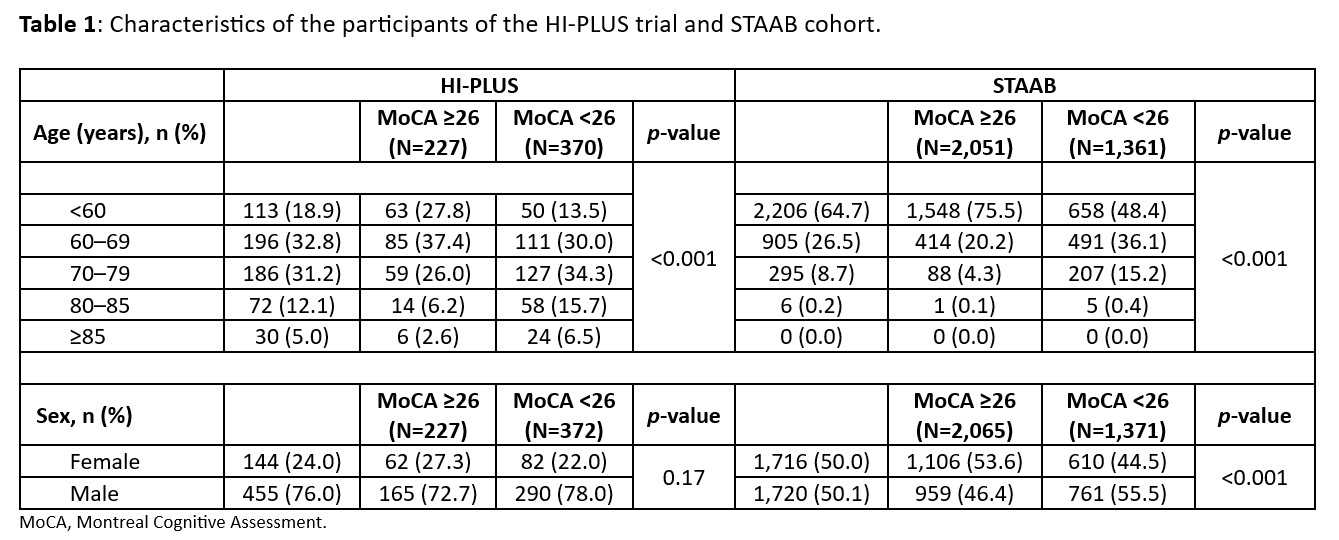
ResultsData from 599 HI-PLUS and 3,437 STAAB participants with information on baseline MoCA were analysed. HI-PLUS participants were on average 68.6±10.7 years old and 76.0% were men. In the STAAB cohort, the average age was 54.0±11.5 years and 50.1% of participants were men. Mean MoCA scores were 23.3±4.3 for the HI-PLUS trial and 25.8±3.2 for the STAAB cohort. The prevalence of mild CI was 54.4% in HI-PLUS and 38.0% in STAAB, while the frequency of more advanced CI was 7.7% and 1.9%, respectively. HF patients had higher odds of a MoCA score <26 (OR 2.36, 95% CI 1.97–2.83, p<0.001) compared with participants from the general population, but this association vanished after adjustment for age and sex (OR 1.09, 95% CI 0.89–1.37, p=0.392). Age, sex, educational level, and anxiety symptoms were associated with a higher risk of CI, whereas higher QoL was associated with lower risk.
ConclusionImpaired cognitive function is a frequent finding in both HF and the general population. It is predominantly driven by higher age, male sex, lower educational level, higher anxiety burden, and worse QoL. The HF syndrome did not emerge as an independent risk factor. Future research should evaluate interventions designed to improve or maintain cognitive function and identify elements that contribute to their effectiveness in adults at high risk of CI. Furthermore, research with extended follow-up periods is needed to investigate long-term determinants of CI among both HF patients and the general population.