Background:
Peripartum cardiomyopathy (PPCM) is a possibly life-threatening disease affecting women prior, during or after birth, defined as heart failure with a left ventricular (LV) ejection fraction (LVEF) lower than 45% and no symptoms beforehand.
Previous investigations showed an altered arachidonic metabolism in PPCM-patients. Free arachidonic acid can be further processed into prostaglandins via the cyclooxygenase pathway. Prostaglandin analogues and oxytocin are uterotonic agents to induce labor, commonly used in obstetrics. Here, we investigated whether PPCM patients from the German PPCM registry received labor-inducing medications more frequently compared to overall German birth statistics, and whether these uterotonic agents had an impact on cardiac function and recovery of PPCM patients.
Methods and Results:
Overall, 111 of 281 PPCM patients of the German PPCM registry diagnosed between 2005 and 2024 provided medical records with further details regarding their delivery. 52% of patients (n=58) were treated with uterotonic agents intrapartum whereas 48% patients (n=53) did not receive any pharmacological induction of labor (IOL). The rate of IOL in PPCM patients was compared to all pregnancies in Germany in the corresponding timeframe. Among PPCM-patients, 38% received uterotonic agents right before delivery, compared to 21% of all pregnant women in Germany (P<0.0001).
PPCM patients, who received prostaglandins and/or oxytocin treatment (POT) intrapartum, were compared with PPCM patients, who did not receive pharmacological treatment for uterine contractions (NPT). Median time between delivery and PPCM diagnosis postpartum was 5 days in the POT- and 4 days in the NPT-cohort (n.s.). Significantly more PPCM patients in the POT-cohort suffered from birth complications as one indication for IOL compared to NPT-cohort (93% vs. 69%, P=0.0023). Also, more POT-patients had a higher pregnancy median duration than the NPT-patients (268 (215-293) days vs. 257 (164-287) days, P=0.0050). Caesarean section was the common mode of delivery with 39 patients (67%) in the POT- and 43 patients (82%) in the NPT-cohort. Furthermore, 47% POT-patients (n=27) and 40% NPT-patients (n=21) suffered from hypertensive disorders of pregnancy (n.s.).
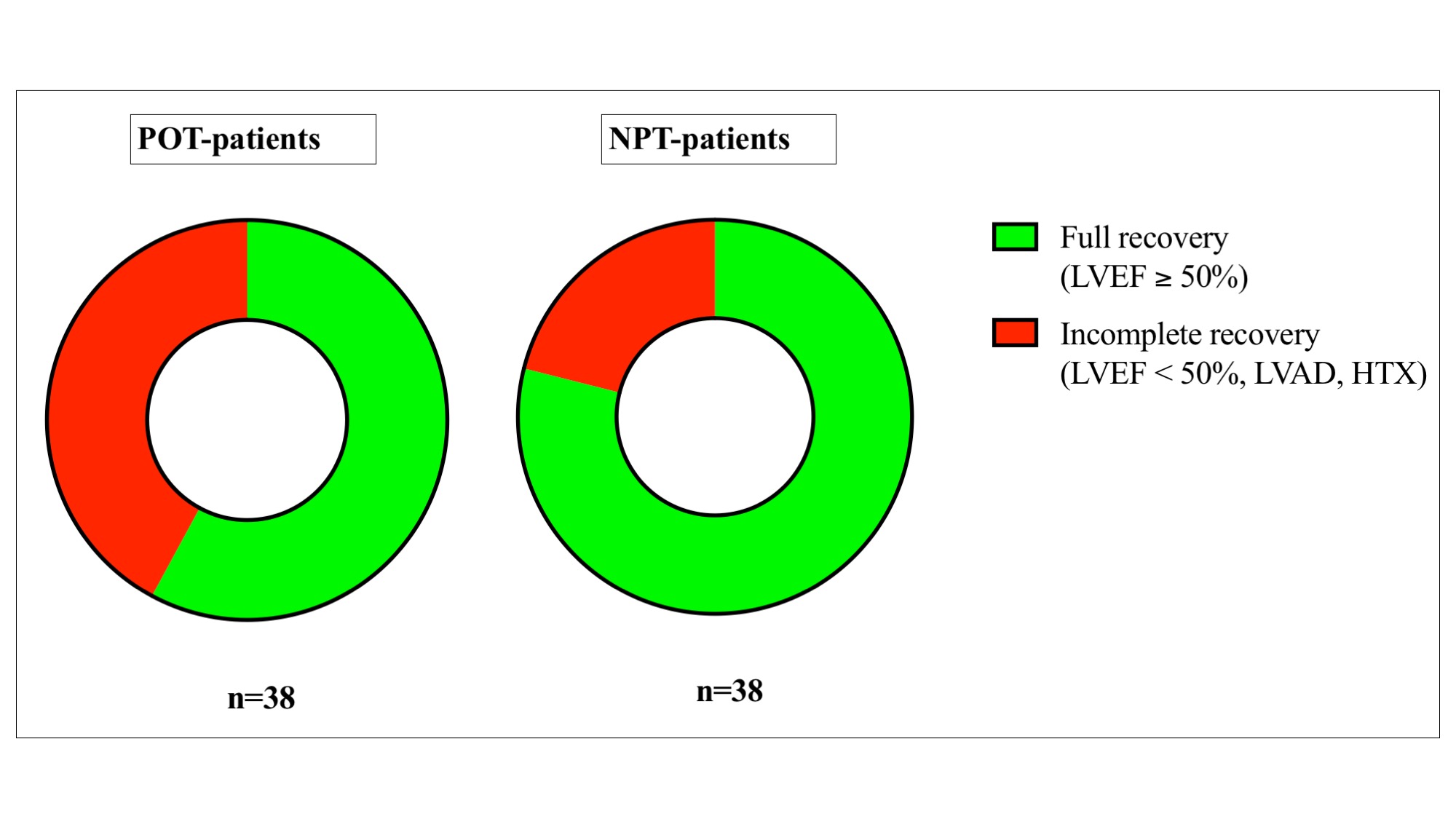
In both cohorts, PPCM-patients presented with LV systolic dysfunction with a mean LVEF of 32±11% (POT, n=56) vs. 30±13% (NPT, n=52) at diagnosis (baseline). Within 6 months follow-up, mean LVEF increased in both groups to 52±8% (POT, n=33) vs. 54±9% (NPT, n=38; n.s.). Full cardiac recovery was observed in 58% of POT-patients (n=22), whereas 42% of POT-patients (n=16) still had an incomplete cardiac recovery (LVEF <50%). 79% of NPT-patients (n=30) presented with a full functional recovery and 21% (n=8) still had an LVEF lower than 50% (Figure). Less POT-patients in this collective attained full cardiac recovery than NPT-patients (P=0.0484).
Conclusion:
PPCM-patients are more likely to receive pharmacological treatment in terms of IOL, which may be due to a higher risk at birth related to comorbidities such as hypertensive disorders of pregnancy compared to all German pregnancies. Additionally, PPCM POT-patients displayed a reduced percentage reaching full cardiac recovery after 6 months compared to PPCM NPT-patients. Thus, POT treatment might be a potential risk factor for PPCM disease onset and worse prognosis.