Background:
Pregnancy imposes major haemodynamic stress, with increased blood volume, cardiac output, and cardiac loading. Whether this leaves a durable valve-relevant cardiac imprint remains uncertain. We examined recorded pregnancy history in relation to incident non-rheumatic valvular heart disease (VHD) and cardiac MRI markers of left-sided cardiac remodelling.
Methods:
We studied 261,168 UK Biobank individuals aged 40 to 69 years at baseline without prevalent or undated VHD. Individuals were classified as ever versus never pregnant using recorded live-birth or hypertensive-disorder-of-pregnancy evidence. The primary outcome was incident composite non-rheumatic mitral, aortic, or tricuspid VHD. Fine-Gray subdistribution hazard models treated all-cause death as a competing event. The fully adjusted model included age, hypertension, body mass index, Townsend deprivation index, ethnicity, and smoking. Sensitivity analyses included direct age standardization, cause-specific Cox models, attained-age timescale models, parity categories, and restriction to individuals aged 45 years or older. In 18,892 individuals with available cardiac MRI traits, indexed left atrial (LA) volume and left ventricular (LV) myocardial mass were related to later VHD and to pregnancy history.
Results:
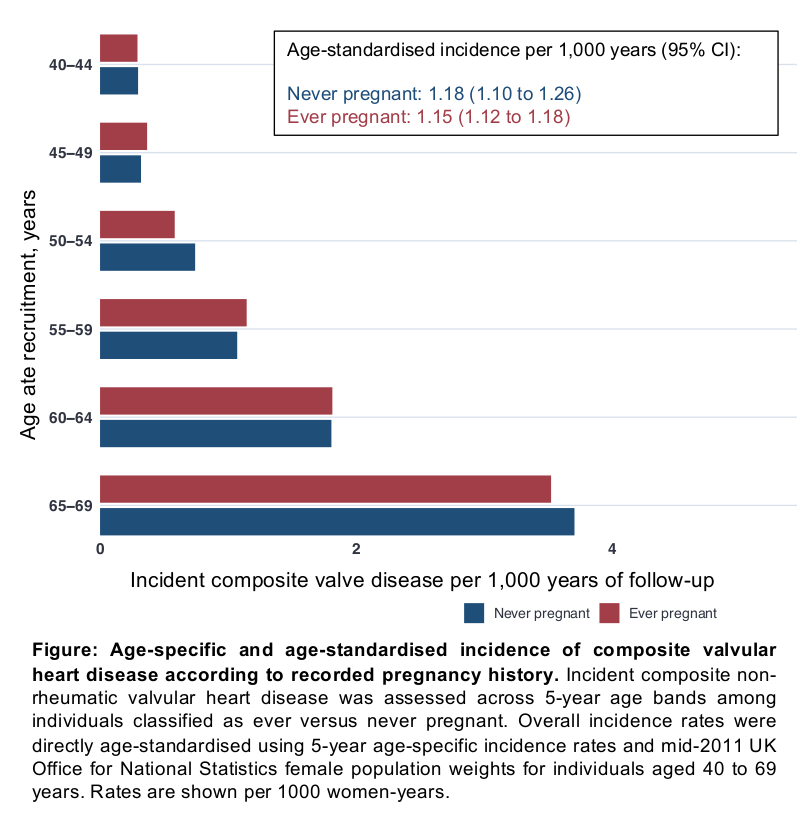
During 4,192,420 person-years of follow-up, median 16.7 years, 5,922 incident composite VHD events occurred. Recorded pregnancy history was associated with higher VHD risk in crude analysis, subdistribution hazard ratio [SHR] 1.28, 95% CI 1.19 to 1.37, but the association attenuated after full adjustment, SHR 0.97, 95% CI 0.91 to 1.05, and after direct age standardization, 1.18 versus 1.15 events per 1000 years. No independent association was observed for aortic, SHR 0.94, 95% CI 0.85 to 1.04, mitral, SHR 1.02, 95% CI 0.92 to 1.13, or tricuspid VHD, SHR 0.94, 95% CI 0.69 to 1.28. Parity, attained-age, cause-specific, and age-restricted analyses were concordant. By contrast, greater indexed LA volume and LV myocardial mass were associated with later VHD, SHR per SD 1.40, 95% CI 1.23 to 1.58, and 1.41, 95% CI 1.27 to 1.56, respectively. However, recorded pregnancy history was not associated with an adverse LA phenotype, adjusted difference −0.01 SD, 95% CI −0.05 to 0.02, and was associated with only marginally higher LV mass, 0.05 SD, 95% CI 0.02 to 0.09.
Conclusions:
Pregnancy history was neither independently associated with incident non-rheumatic valvular heart disease nor accompanied by a left-sided cardiac remodelling phenotype on MRI relevant for left sided VHD. Although adverse pregnancy phenotypes remain important cardiovascular risk markers, pregnancy per se should not be portrayed as a general cardiovascular exposure that necessarily increases later risk of valvular heart disease.